African Grey parrots are often called the smartest birds on the planet, and for good reason. Their cognitive abilities have been studied extensively by researchers, most famously through Dr. Irene Pepperberg’s decades-long work with Alex the African Grey, who demonstrated skills once thought exclusive to primates and young children.
But intelligence in African Greys isn’t static from hatching to old age. It develops in stages, much like it does in humans, and understanding this timeline helps owners set realistic expectations and provide the right kind of mental stimulation at each life stage.
This guide breaks down how African Grey cognitive ability typically develops with age, what skills emerge at each stage, and how owners can support healthy mental growth throughout their bird’s life.
Table of Contents
Why African Greys Are Considered So Intelligent

Before diving into the age breakdown, it helps to understand what “intelligence” actually means in this context. Researchers typically measure parrot cognition through:
- Problem-solving ability — working out puzzles, retrieving hidden objects, and using tools
- Language comprehension — understanding words in context, not just repeating sounds
- Concept formation — grasping abstract ideas like same/different, bigger/smaller, and zero
- Memory — recalling people, routines, locations, and past experiences over long periods
- Emotional and social awareness — recognizing moods, forming attachments, and responding to social cues
African Greys score remarkably well across all of these categories compared to most other parrot species, which is why they’re frequently compared to dolphins, elephants, and great apes in cognitive research.
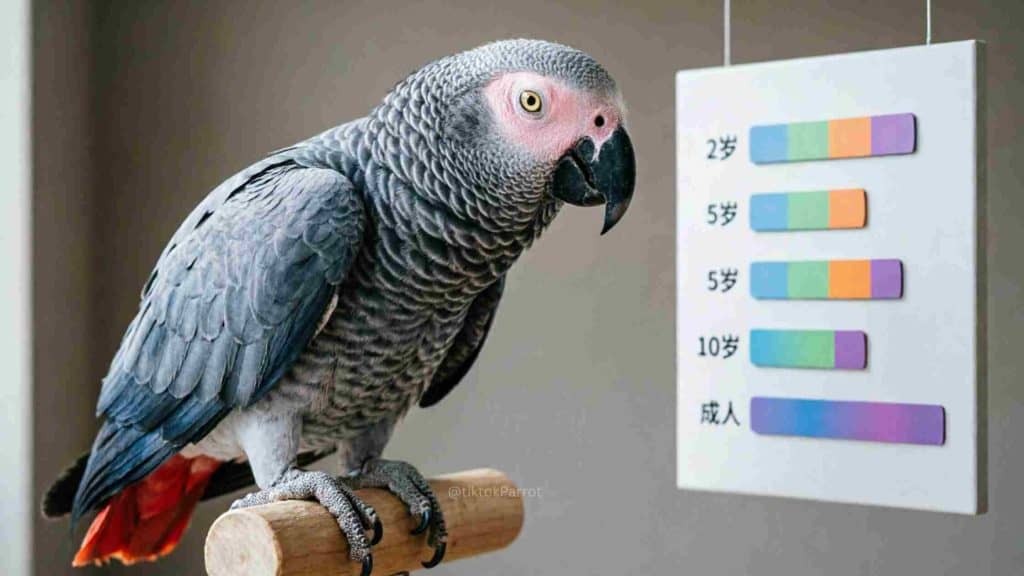
Intelligence Development Chart by Age
| Age Range | Cognitive Stage | Typical Abilities |
|---|---|---|
| 0–8 weeks (Hatchling/Nestling) | Instinctual stage | Basic reflexes, begging behavior, no learned vocabulary yet |
| 2–6 months (Fledgling/Weaning) | Early exploration | Beginning to mimic sounds, exploring environment, forming first bonds |
| 6–12 months (Juvenile) | Rapid learning phase | Learning first words, testing cause-and-effect through play, developing food preferences |
| 1–3 years (Young Adult) | Cognitive expansion | Expanding vocabulary, solving simple puzzles, recognizing routines and individual people |
| 3–7 years (Maturing Adult) | Peak learning years | Complex problem-solving, contextual word use, understanding basic categories and quantities |
| 7–20 years (Established Adult) | Cognitive peak | Full vocabulary use in context, advanced puzzle-solving, strong emotional intelligence and memory |
| 20+ years (Senior) | Sustained intelligence with gradual decline | Retained vocabulary and memory, possible slower processing speed, continued benefit from mental stimulation |
It’s worth noting that these stages are general patterns rather than rigid rules. Individual Greys vary based on genetics, environment, diet, and how much mental stimulation they receive early in life.
Breaking Down Each Stage
Hatchling to Weaning (0–6 Months)
At this stage, cognitive development is mostly about basic survival instincts and early social bonding. Chicks begin recognizing their caregivers and start experimenting with sounds, though true speech mimicry hasn’t developed yet. This is a critical socialization window; positive, gentle handling now lays the groundwork for a confident, trusting adult bird later.
Juvenile Stage (6–12 Months)
This is when owners typically notice the first real signs of intelligence. Young Greys start mimicking household sounds, testing objects by dropping or manipulating them, and forming preferences for specific toys, foods, or people. Their brains are highly plastic at this stage, making it an excellent window for introducing basic training and word association.
Young Adult (1–3 Years)
Vocabulary expands significantly during this period, and many Greys begin using words with apparent intention rather than pure mimicry, such as saying “up” when they want to be picked up. Puzzle toys and foraging games become genuinely engaging rather than simply novel, and problem-solving becomes noticeably more sophisticated.
Maturing Adult (3–7 Years)
This period often overlaps with sexual maturity, and cognitive development continues alongside hormonal changes. Greys in this stage can typically grasp categorical concepts, such as distinguishing colors, shapes, and materials, and many can respond appropriately to simple questions.
Peak Cognitive Years (7–20 Years)
Most experts agree this is where African Greys hit their cognitive stride. Alex the parrot, the subject of Dr. Pepperberg’s research, demonstrated skills like identifying object attributes, understanding the concept of zero, and combining words in novel ways well into this age range. Owners often describe birds at this stage as remarkably intuitive, sometimes seeming to anticipate routines or moods before they’re expressed.
Senior Years (20+ Years)
Cognitive decline in aging Greys tends to be gradual rather than dramatic, especially in birds who’ve had consistent mental engagement throughout life. Vocabulary and memory are often well-preserved, though some owners notice slightly slower responses or reduced interest in high-energy puzzle toys. Continued mental stimulation remains important for quality of life at this stage.
How to Support Cognitive Development at Every Age
- Introduce puzzle toys early and increase complexity as your bird matures.
- Rotate toys regularly to prevent boredom and encourage continued problem-solving.
- Talk to your bird consistently, using words in context rather than just repeating random phrases.
- Provide foraging opportunities that mimic natural food-finding behavior.
- Maintain a consistent routine, since predictability supports memory and emotional security.
- Keep senior birds engaged with familiar, lower-difficulty puzzles rather than assuming reduced activity is preferable.
Common Mistakes Owners Make
- Underestimating young birds. Juveniles are far more capable of learning than many owners assume, and delaying stimulation can slow development.
- Assuming intelligence peaks and then fades quickly. In reality, well-cared-for Greys often retain sharp cognitive abilities well into their senior years.
- Relying only on repetition-based toys. True cognitive growth benefits from novelty and genuine problem-solving, not just repetitive play.
- Neglecting mental stimulation in older birds. Senior Greys still benefit significantly from engagement, even if their pace slows.
Frequently Asked Questions
At what age are African Grey parrots the smartest?
Most experts point to the 7-to-20-year range as peak cognitive performance, though well-stimulated birds often retain strong abilities well beyond that.
Do African Grey parrots get smarter with age?
Yes, cognitive ability typically develops steadily from hatchling to adulthood, with continued learning capacity throughout most of their long lifespan.
How intelligent is an African Grey compared to a human child?
Research on Alex the parrot suggested cognitive and communicative abilities in some tasks comparable to a 4-to-6-year-old child, though this comparison applies to specific cognitive tasks rather than overall intelligence.
Can older African Grey parrots still learn new words?
Yes, senior Greys can typically continue learning new words and behaviors, though the pace may be somewhat slower than in younger birds.
When should I start training my African Grey parrot?
Early socialization and basic word association can begin during the juvenile stage, around 6 to 12 months of age, when the brain is highly receptive to learning.
Does diet affect an African Grey’s intelligence?
A balanced, nutrient-rich diet supports healthy brain development and function throughout life, while poor nutrition can negatively affect cognitive performance and energy levels.
Do all African Grey parrots develop intelligence at the same rate?
No, individual development varies based on genetics, environment, early socialization, and the amount of mental stimulation provided by their owner.
Conclusion
African Grey parrots follow a fascinating cognitive journey, from instinct-driven hatchlings to remarkably perceptive adults capable of complex problem-solving and contextual language use. Understanding this age-based development helps owners provide the right level of stimulation at each stage, ensuring their bird’s impressive intellect is nurtured rather than left untapped.
Whether you’re raising a curious juvenile or caring for a wise senior Grey, consistent engagement remains the single best way to support their remarkable minds throughout their long lives.
If this blog post has helped you, please share it with your family and friends who might also find it helpful. If you love African Greys, join our community of Grey owners! You can meet other owners, share tips and learn from each other.
Stay safe and much love!


Hey there! 🐾 Looking for top-notch pet supplies or anything on Amazon?
Support our site by shopping on Amazon through our this referral link, it will not cost you extra!
Your purchases on Amazon can help us continue providing valuable content.
Thank you for your support! 🛍️