Figuring out how old an African Grey actually is can feel like a genuine puzzle, especially if you’ve adopted a bird without paperwork or purchased one secondhand. The good news is that young African Greys offer several reliable physical clues, most notably their eye color, that can help narrow down an age estimate. The less good news is that once a Grey reaches full maturity, usually somewhere around 4 to 5 years old, these visual cues stop changing, and estimating age becomes considerably harder.
This guide walks through the most reliable methods for estimating an African Grey’s age, what to expect at each life stage, and why age becomes genuinely difficult to pin down in mature birds.
Table of Contents
Why Documentation Is Always the Best Starting Point

Before looking at any physical indicators, it’s worth emphasizing that the only truly reliable way to know an African Grey’s exact age is documentation from the breeder or a leg band. Reputable breeders keep detailed hatch records and can often provide an exact or estimated hatch date. Many breeders also place a small metal or plastic leg band on young birds, imprinted with identifying numbers that can be traced back to breeder records.
If you have access to either of these, that information will always be more accurate than any physical estimation method described below.
Eye Color: The Most Useful Visual Indicator
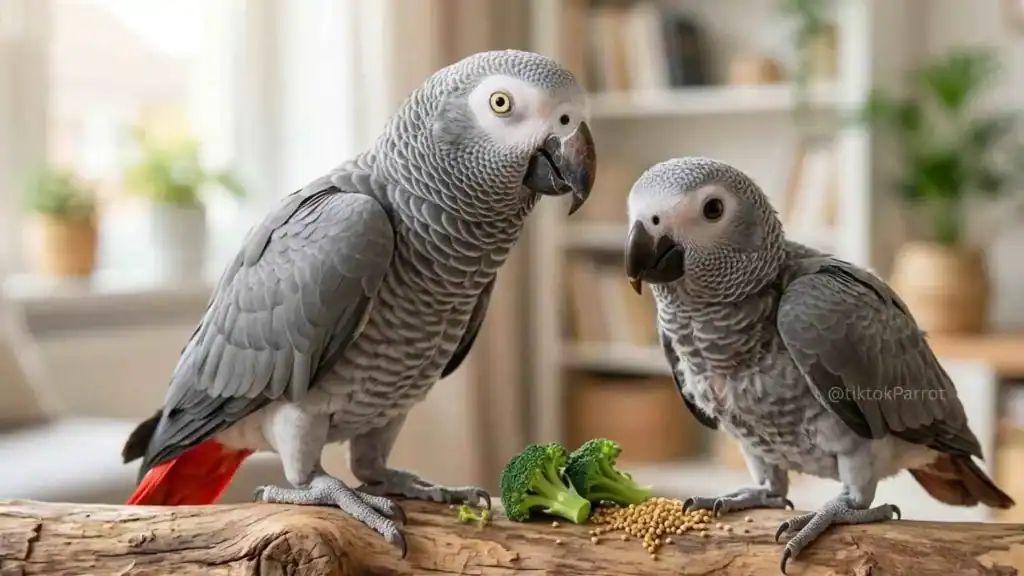
For African Greys younger than about 4 to 5 years old, eye color offers a genuinely useful, fairly consistent way to estimate age:
- Under 4–6 months: Eyes appear very dark, almost solid black or dark grey, with little to no visible iris distinction
- Around 1 year: Eyes lighten to a gray shade
- Around 18 months to 2 years: Eyes shift toward a pale straw or yellow-brown tone
- 3 to 5 years: Eyes reach a light yellow color as the bird approaches full maturity
This gradual lightening happens as the iris itself changes color with maturity, and it remains one of the most commonly cited methods for estimating age in young African Greys. It’s worth noting, though, that eye appearance can also temporarily change due to emotional state; a startled or excited bird may show a larger white pupil area briefly, which reflects mood rather than age and shouldn’t be factored into an age estimate.
Tail Feather Color
Tail coloration offers another helpful clue, particularly for distinguishing juveniles from adults:
- Juveniles typically have duller, darker grey tail feathers
- Adults develop the vivid red or maroon tail feathers African Greys are known for
This transition generally occurs alongside the broader maturation process and can serve as a secondary confirmation alongside eye color when estimating a young bird’s age.
Molting Patterns
African Greys go through their first significant molt somewhere between about 1.5 and 2 years of age, shedding juvenile feathers in favor of adult plumage. Observing whether a bird has completed this molt, and roughly when it appears to be happening, can offer another supporting data point when combined with eye color and tail feather observations.
Size and Weight
Adult Congo African Greys typically measure around 12 to 14 inches in length and weigh somewhere between roughly 400 and 650 grams, while Timneh African Greys run slightly smaller, generally 9 to 11 inches and around 275 to 400 grams. A bird noticeably smaller than these ranges may still be young and not yet fully grown, though this method works best as a supporting indicator rather than a primary one, since individual variation exists even among fully mature adults.
Behavioral Clues
While far less precise than physical indicators, general behavior can offer a rough supporting impression:
- Younger birds often display more overt playfulness, curiosity, and exploratory behavior
- Mature adults tend toward calmer, more focused interactions
- Very senior birds may show reduced activity levels and a preference for quieter engagement
Behavior alone is far too variable between individual birds to reliably estimate age on its own, but it can add supporting context alongside the more concrete physical signs above.
Why Age Becomes Nearly Impossible to Estimate After Maturity
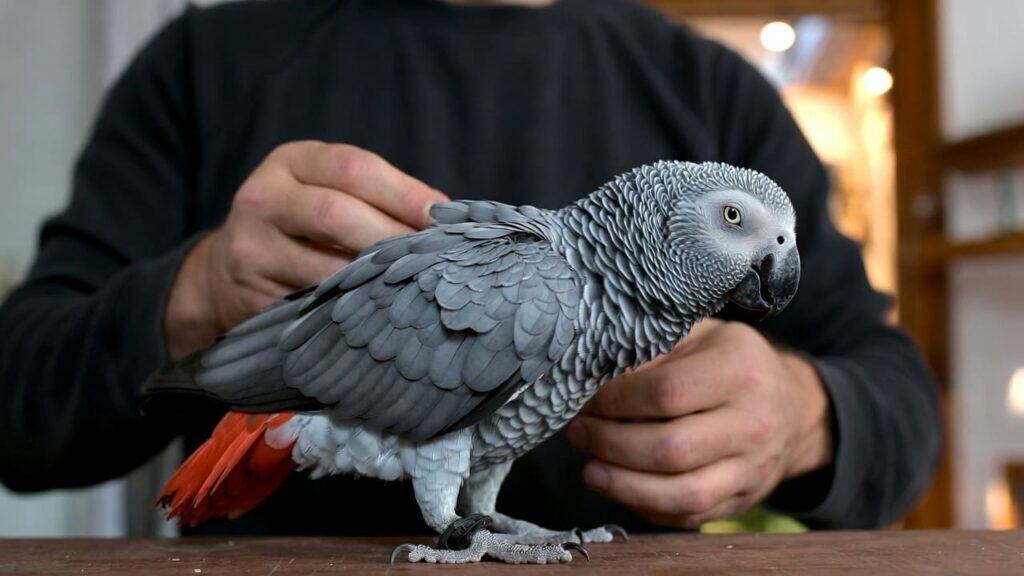
Here’s the central challenge: once an African Grey reaches full maturity, generally somewhere around 4 to 5 years old, its eye color, tail feathers, and general appearance essentially stop changing in any visually trackable way.
A bird could be 6 years old or 40 years old and look remarkably similar from the outside. Given that African Greys commonly live 40 to 60 years in captivity, this means the vast majority of a bird’s life falls into a period where visual age estimation simply isn’t reliable.
This is precisely why adopting an African Grey of unknown age carries real long-term planning considerations; a bird presented as “adult” could be anywhere from a few years old to well into middle age or beyond, with essentially no way to narrow that down further through observation alone.
Getting Help From an Avian Veterinarian
If visual indicators aren’t conclusive, or if your bird already appears to be a mature adult, an avian veterinarian can sometimes offer additional insight based on overall health indicators, behavior patterns, and general condition, drawing on professional experience with birds across various life stages.
While this still won’t provide an exact age for a mature bird, an experienced avian vet may be able to offer a reasonable estimated age range based on accumulated clinical experience.
Blood testing for hormone levels has also been mentioned as a potential tool some vets use when trying to narrow down maturity status, though this is generally more useful for confirming whether a bird has reached breeding maturity rather than pinpointing an exact age.
Common Mistakes People Make
- Assuming eye color estimation works at any age. This method is only useful up to roughly 4-5 years old; after that, eye color simply stops changing in a trackable way.
- Mistaking a startled expression for an age indicator. Temporary pupil changes from excitement or fear reflect mood, not age.
- Relying on size alone. Individual variation among fully grown adults means size is only a rough supporting clue, not a standalone method.
- Assuming a bird sold as “adult” has a knowable age. Without breeder records or a leg band, adult African Greys are genuinely difficult to age precisely.
- Overlooking leg bands. If a bird has one, tracing it back to breeder records is often the most reliable path to an accurate age.
Frequently Asked Questions
How can I tell how old my African Grey parrot is?
The most reliable method for young birds is observing eye color, which progresses from dark black or grey in early months to light yellow by around 3 to 5 years of age.
At what age do African Grey parrots’ eyes turn yellow?
Eyes typically reach a light yellow color somewhere between 3 and 5 years of age, as the bird approaches full maturity.
Can I tell an African Grey’s age once it’s fully grown?
Not reliably through visual observation alone. Once a Grey reaches maturity around 4 to 5 years old, physical indicators like eye and tail color stop changing, making age estimation very difficult.
Do tail feathers help determine an African Grey’s age?
Yes, juveniles have duller, darker grey tail feathers, while adults develop the characteristic vivid red or maroon tail coloring, offering a secondary clue alongside eye color.
What’s the most accurate way to know my African Grey’s exact age?
Breeder records or a leg band traced back to breeder documentation remain the most accurate sources, since physical estimation methods only provide a general range.
Can a vet tell me exactly how old my African Grey is?
An avian vet may be able to offer a reasonable age range based on clinical experience and overall condition, but without documentation, an exact age for a mature bird generally isn’t possible to determine.
Why is it so hard to estimate the age of an older African Grey?
Because visual maturation markers like eye and tail color stop changing after full maturity, and African Greys can live 40 to 60 years, meaning most of a bird’s life falls into a period with no reliable visual aging method.
Conclusion
Estimating an African Grey’s age is genuinely possible during the first several years of life, largely thanks to the bird’s gradually changing eye color, alongside tail feather development, molting patterns, and general size.
Once a Grey reaches full maturity, however, these visual cues stop offering any further clues, and exact age becomes essentially unknowable without breeder documentation or a traceable leg band.
If you’re adopting an African Grey without paperwork, it’s worth accepting that “adult” may simply mean somewhere within a very wide range, and planning for the long, multi-decade commitment this remarkable species represents regardless of its exact starting age.
If this blog post has helped you, please share it with your family and friends who might also find it helpful. If you love African Greys, join our community of Grey owners! You can meet other owners, share tips and learn from each other.
Stay safe and much love!


Hey there! 🐾 Looking for top-notch pet supplies or anything on Amazon?
Support our site by shopping on Amazon through our this referral link, it will not cost you extra!
Your purchases on Amazon can help us continue providing valuable content.
Thank you for your support! 🛍️