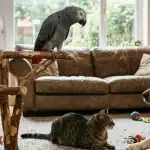
Many pet lovers dream of a home where their African Grey parrot, cat, and dog all coexist peacefully. It’s a heartwarming idea — and for some households, it’s genuinely achievable.
But before you let your Grey share the living room with your golden retriever or let your cat snooze near the cage, there are critical things you need to understand. The stakes are high, and the risks are real. With the right approach, however, a multi-pet home can work safely for everyone involved.
Table of Contents
Understanding the Natural Dynamic Between Predators and Prey
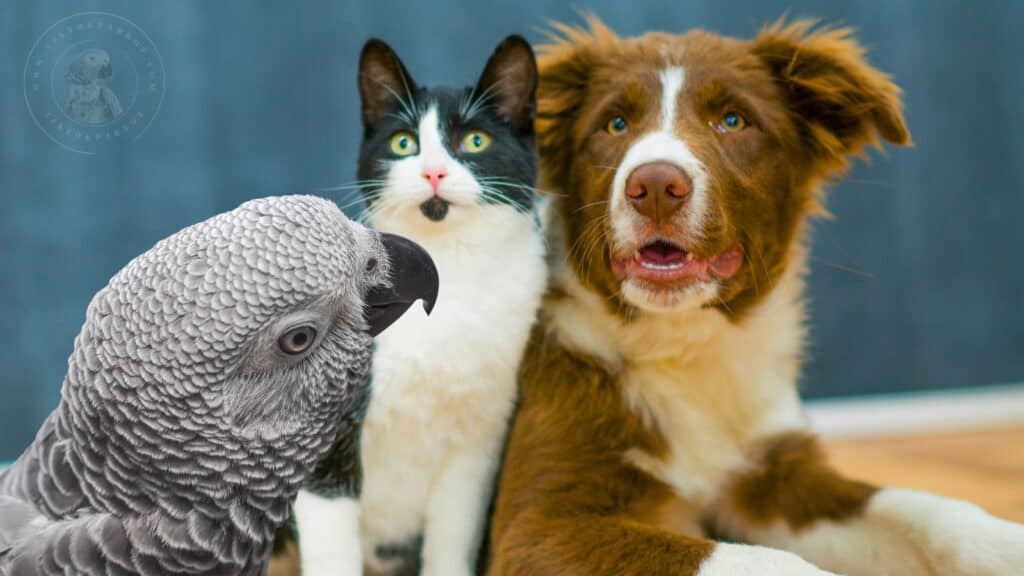
At the most fundamental level, cats and dogs are predators. African Grey parrots are prey animals. This isn’t a personality conflict — it’s hardwired biology. No matter how gentle your dog is or how lazy your cat seems, their instincts never fully switch off.
African Greys are particularly sensitive to stress. As one of the most emotionally intelligent parrot species in the world, they pick up on tension in their environment acutely. Even if your cat simply stares at your Grey’s cage for extended periods, that alone can cause chronic stress for your bird, leading to feather plucking, loss of appetite, and behavioral problems over time.
This doesn’t mean cohabitation is impossible — but it means you must be the one who creates and enforces safety, every single day.
The Real Danger: Bacteria, Claws, and Instinct
Cats
Cats pose a unique and often underestimated danger to parrots. Their claws and teeth carry the bacterium Pasteurella multocida, which is harmless to cats but can be fatal to birds — even from a minor scratch. A cat doesn’t need to seriously injure your African Grey for the encounter to become life-threatening. A single swipe, even a playful one, can introduce bacteria into the bloodstream. Without immediate veterinary treatment, a bird can die within 24 to 48 hours.
This is not an exaggeration. It’s a well-documented medical reality that avian vets deal with regularly.
Dogs
Dogs vary enormously in temperament, but even the calmest breeds carry risk. A dog with a high prey drive — terriers, hounds, herding breeds — can react to a bird’s sudden movement or flapping wings in a split second. Large dogs can knock over or crush a cage. Even small dogs can cause panic in your Grey, which may fly into walls or injure itself trying to escape.
Some dog breeds are more naturally indifferent to birds, and individual personality matters greatly. But breed alone should never be the reason you relax your guard.
Can an African Grey Parrot Actually Live with Cats and Dogs?
Yes — with the right precautions, many African Grey owners successfully share their homes with cats and/or dogs. The key is structured management, never assumption.
Here’s what responsible multi-pet households get right:
1. Separate Spaces Are Non-Negotiable
Your African Grey should have a dedicated room or area that cats and dogs cannot access unsupervised. The bird’s cage should never be reachable by either animal when you are not present to directly supervise. A locked door — not just a closed one — is the appropriate standard for homes with cats, who are famously good at opening doors.
2. All Interactions Must Be Supervised
When your African Grey is out of its cage, cats and dogs should be in a separate room or secured on a leash. There are no exceptions to this rule. “Just for a moment” is how accidents happen. Supervised interactions can be allowed with dogs that have demonstrated calm, reliable behavior, but even then, the bird should always have an easy escape route.
3. Introduce Gradually and Observe Carefully
Slow introductions reduce stress on all animals involved. Allow your dog or cat to observe the bird’s cage from a distance initially. Watch for fixation — a dog or cat that cannot take its eyes off the cage, whines near it, or paws at it is showing predatory interest that needs to be taken seriously.
African Greys are observant. They will notice your other pets and form their own opinions. Some Greys become curious and even playful toward dogs over time. Others remain deeply uncomfortable. Follow your bird’s lead.
4. Train Your Dog Thoroughly
Basic obedience is essential. A dog that responds reliably to “leave it,” “stay,” and “come” is far safer in a multi-pet home than one with inconsistent training. Never allow a dog to chase, bark at, or lunge toward the bird’s cage, even during play.
5. Never Leave Them Unattended Together
This bears repeating because it is the most common mistake: never leave your African Grey and your cat or dog alone in the same space, even if they have coexisted calmly for months or years. Instincts can surface when you least expect them.
Signs Your African Grey Is Stressed by Other Pets
Watch for these behavioral changes, which may indicate your Grey is not coping well with other animals in the home:
- Feather plucking or over-preening
- Screaming more than usual
- Refusing to come out of the cage
- Loss of appetite
- Biting when previously calm
- Night frights and restlessness
If you observe any of these alongside the presence of cats or dogs, reassess your household arrangement and speak with an avian vet or a certified parrot behaviorist.
What African Grey Owners Get Wrong
- Assuming calm behavior means safety: A cat that ignores the cage for months may one day decide to test it. Past behavior is not a guarantee.
- Free-roaming birds: Allowing your Grey to roam the house freely when cats or dogs are present is extremely dangerous. Ground-level birds are particularly vulnerable.
- Believing the animals have “bonded”: Social tolerance between animals is not the same as safety. Even birds and dogs that appear friendly can have an incident triggered by prey instinct.
- Delaying veterinary care after contact: If your cat or dog makes any physical contact with your African Grey — even a light scratch — treat it as a medical emergency and contact an avian vet immediately.
Frequently Asked Questions
Can African Grey parrots and cats get along?
They can learn to tolerate each other’s presence, but they should never be left unsupervised together. Even a minor scratch from a cat can be fatal to a parrot due to bacteria on a cat’s claws and teeth. Always maintain strict separation.
Can dogs and African Grey parrots coexist peacefully?
Yes, especially with well-trained, low-prey-drive dogs and gradual introductions. However, all interactions must be supervised, and the bird should never be left alone with a dog regardless of how gentle the dog appears.
What happens if a cat scratches an African Grey parrot?
The bacterium Pasteurella multocida found on cat claws can cause a rapid, life-threatening infection in birds. This requires immediate emergency veterinary care — even a small scratch can be fatal within 24–48 hours without treatment.
How do I introduce my dog to my African Grey parrot?
Start with the dog on a leash at a distance from the cage. Reward calm behavior. Gradually reduce distance over days or weeks. Never allow rushing, barking, or fixation. The bird should always be able to retreat to a safe space.
Will my African Grey parrot be stressed by living with cats and dogs?
Possibly. African Greys are very sensitive birds. The constant visual presence of predatory animals can cause chronic stress. Watch closely for behavioral changes like feather plucking, screaming, or appetite loss, and adjust your household setup if needed.
Conclusion
An African Grey parrot, a cat, and a dog can share the same home — but only if you treat their safety as an ongoing responsibility, not a one-time introduction. The biology is clear: cats and dogs are predators, and African Greys are prey. No amount of good behavior from your other pets changes that fundamental reality. What changes it is your management, your vigilance, and your commitment to keeping your Grey safe every single day.
With separate spaces, consistent supervision, solid dog training, and a zero-tolerance policy for unsupervised contact, many African Grey owners make it work beautifully. The key is never letting your guard down — because your Grey is counting on you.
If this blog post has helped you, please share it with your family and friends who might also find it helpful. If you love African Greys, join our community of Grey owners! You can meet other owners, share tips and learn from each other.
Stay safe and much love!


Hey there! 🐾 Looking for top-notch pet supplies or anything on Amazon?
Support our site by shopping on Amazon through our this referral link, it will not cost you extra!
Your purchases on Amazon can help us continue providing valuable content.
Thank you for your support! 🛍️